Busy, tired, and not in the mood for a full workout? Perfect. You don’t need a 60‑minute sweat session to stay active—you just need tiny, repeatable moves that fit inside your day without wrecking your schedule. These micro habits are sneaky, low-effort, and designed for real life, not gym fantasies.
Let’s plug movement into the day you already have.
Why Micro Habits Work When Your Schedule Doesn’t
Micro habits are ultra-small actions that are:
- Easy enough to do even when you’re tired
- Fast enough to fit between emails, meetings, or parenting chaos
- Consistent enough to actually stick
You’re training your brain, not just your body. Each tiny action is a “vote” for the identity of “I’m someone who moves.” Over time, these little votes add up to better energy, stronger muscles, and a healthier heart—without needing perfect motivation or a perfect routine.
Science backs this up: short bouts of movement across the day can improve cardiovascular health, boost insulin sensitivity, and lift mood, especially if you’re usually glued to a chair. So instead of chasing the “perfect” workout, let’s build a day that doesn’t let you stay still for too long.
Tip 1: Anchor a 30-Second Move to Stuff You Already Do
Forget “I’ll work out later.” Tie movement to something that already happens, every single day.
Pick a daily anchor and attach one micro move:
- After you start the coffee machine → 30 seconds of counter push-ups
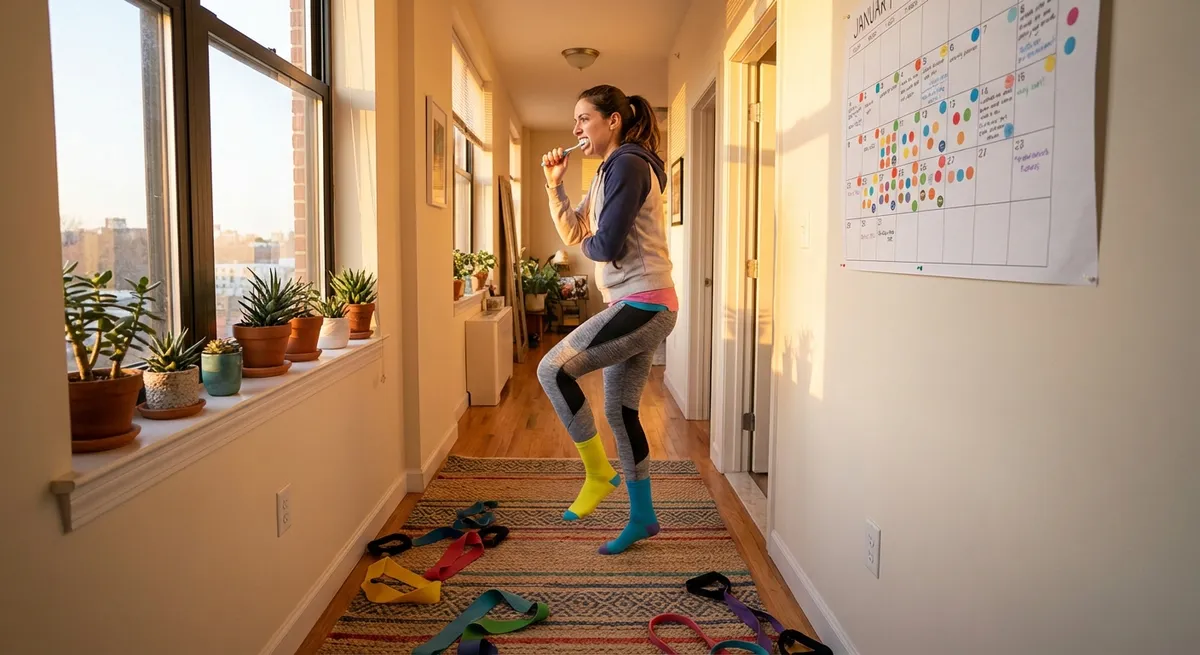
- After you brush your teeth → 30 seconds of bodyweight squats
- After you hit “Join” on a video call (while you wait) → 30 seconds of marching in place
- No equipment
- No changing clothes
- No thinking required
Keep it simple:
Your only job: same move, same moment, every day. Once it’s baked into your routine, you’ve got a built-in fitness trigger that doesn’t care how busy you are.
Tip 2: Turn Waiting Time Into Movement Time
Every “just standing around” moment is a hidden workout window. Instead of scrolling, stack tiny moves on top of waiting.
Try this:
- Microwave minute: While food heats, do heel raises holding the counter
- Kettle time: Side leg lifts or gentle hip circles
- Loading the dishwasher: Add 5–10 squats while you go from sink to machine
- Standing in line: Subtle glute squeezes or calf raises (no one needs to know)
The goal isn’t to “feel destroyed.” It’s to teach your body that idle time ≠ zero movement. Three or four of these micro bursts spaced through the day beats one “I meant to work out” that never happens.
Tip 3: Use the “Two-Minute Move Rule” for Energy Slumps
When your brain says “I have no energy,” answer with this rule:
If it takes two minutes or less, do it now.
Pick one move and give it just 120 seconds:
- Slow stairs up and down
- Light wall sits
- Gentle walking laps around your home or office
- Easy shadow boxing in place
Two minutes is short enough that your brain won’t fight it, but long enough to nudge your heart rate, circulation, and focus. If you feel better afterward, do another two minutes. If not, you still win—you moved.
Tip 4: Make Screens Your Movement Reminder, Not Your Time Thief
Your phone and laptop can be your biggest fitness blockers—or your sneakiest allies.
Micro habits to attach to screens:
- Every time you hit “Send” on three emails: Stand up and stretch your chest and hip flexors
- Every episode or YouTube video: Move during the intro or ads—march in place, shoulder rolls, light lunges
- Every social scroll break: Before opening an app, do 10 squats or 10 calf raises
You don’t need a fancy app to start. A simple repeating reminder like “Stand + stretch for 60 seconds” every 60–90 minutes can cut long sitting marathons into healthier, bite-sized chunks.
Tip 5: Build a 5-Move “Micro Circuit” for Crazy Days
When your day is chaos, having a pre-built mini circuit removes all the decision-making. Use this plug-and-play set—no equipment, no space, no excuses.
Do each for 20–30 seconds. Rest 10–20 seconds. Run through once, or repeat if you have more time.
March in place – Drive knees gently, swing arms
Bodyweight squats or sit-to-stands – From a chair if needed
Wall push-ups – Hands on the wall, step back slightly
Standing side leg raises – Hold a chair or counter for balance
Standing trunk rotations – Slow twists, elbows out, core lightly engaged
Total: 3–5 minutes max. Drop this micro circuit:
- Before your morning shower
- Between meetings
- Right after work to reset before the evening
Even once a day makes a difference. Several times a day? You’ve quietly built a real training habit without ever “going to work out.”
Conclusion
You don’t need more time—you need smaller moves.
Micro habits work because they:
- Slide into the day you already have
- Don’t rely on motivation or willpower
- Stack up into real, measurable change
- Anchor a move
- Use wait time
- Apply the two-minute rule
- Attach movement to screens
- Run a micro circuit
Pick one tip from this article and start today:
Keep it tiny, keep it doable, and let consistency do the heavy lifting.
Sources
- Centers for Disease Control and Prevention – Physical Activity Basics - Overview of why regular movement (even in small bouts) supports long-term health
- American Heart Association – Move More, Sit Less - Explains how breaking up sitting time with light activity benefits heart health
- Harvard T.H. Chan School of Public Health – The Benefits of Exercise - Details the wide-ranging health perks of physical activity, including short, frequent bouts
- Mayo Clinic – Exercise: 7 Benefits of Regular Physical Activity - Covers how consistent movement boosts mood, sleep, and energy
- National Institutes of Health – Short Bouts of Physical Activity and Health - Research review on how brief, accumulated activity throughout the day can improve health outcomes
Key Takeaway
The most important thing to remember from this article is that this information can change how you think about Micro Habits.