If your schedule is packed and your energy feels stuck in airplane mode, micro habits are your new power tool. These are tiny, repeatable actions that fit inside the cracks of your day—but still move the needle on strength, stamina, and mood. No full outfit change. No commute to the gym. Just small, smart moves that add up fast.
Let’s plug a few into your day so your body wakes up, even when your calendar is already loud.
Why Micro Habits Beat “All-or-Nothing” Workouts
Big, perfect workouts are great… when they actually happen. Micro habits win because they’re almost impossible to skip.
Micro habits shrink the “activation energy” it takes to start. Instead of “45 minutes at the gym,” you say, “30 seconds of movement before I grab my coffee.” Your brain stops negotiating, because the bar is low—but the repeat rate is high.
Research shows that even small doses of movement improve insulin sensitivity, blood pressure, and mood. Short “exercise snacks” spread through the day can rival one longer session for health benefits, especially if you’re mostly sitting. Over time, these micro bursts become automatic: you pour coffee, you move; you close your laptop, you stretch. That repetition builds identity: you’re not “trying to be active”—you are an active person doing small active things all day.
The trick: anchor each micro habit to something you already do, like brushing your teeth, checking email, or heating lunch. Same cues, new outcome.
Quick Tip #1: The “Doorway Drop” Squat Habit
Trigger: Every time you walk through a specific doorway at home (bedroom, office, or kitchen).
Action: Drop into 5 slow bodyweight squats, then move on.
Keep your feet about shoulder-width apart, chest lifted, and sit your hips back like you’re aiming for a chair. Go as low as feels comfortable, then stand up with control. Five squats take roughly 20 seconds—but walk through that doorway 5–10 times per day and you’ve quietly racked up 25–50 squats.
Why it works: You’re not “doing a workout,” you’re just adding a movement rule to a place you already pass repeatedly. Over time, your legs get stronger, your hips stay more mobile, and climbing stairs or standing up from chairs feels easier.
If 5 is too much at first, start with 2 squats per doorway and build up.
Quick Tip #2: The “Loading Bar Plank” During Tech Time
Trigger: Waiting for something on a screen—video ad, file upload, software update, or slow web page.
Action: Drop to the floor for a 20–30 second plank while you wait.
Plant your forearms on the floor, elbows under shoulders, legs straight behind you. Squeeze your glutes, brace your core, and keep your body in a straight line from head to heels. If that’s too intense, plank on your kitchen counter or desk instead.
These tiny planks sneak in serious core work: shoulders, abs, and glutes fire up, posture muscles turn on, and your back gets more support for the rest of your sitting-heavy day. Hit 4–6 “loading bar planks” scattered through your day and you’ve stacked a solid couple of minutes of core time without blocking off your calendar.
Quick Tip #3: The “Hydration + Movement” Stack
Trigger: Every time you refill your water bottle or grab a drink.
Action: Pair hydration with a 30-second movement burst.
Pick one move and stick to it for a week:
- Week 1: 20 heel raises (rise onto your toes, lower slowly)
- Week 2: 15 countertop pushups
- Week 3: 20 marching high knees in place
- Week 4: 10–15 standing lunges (alternate legs)
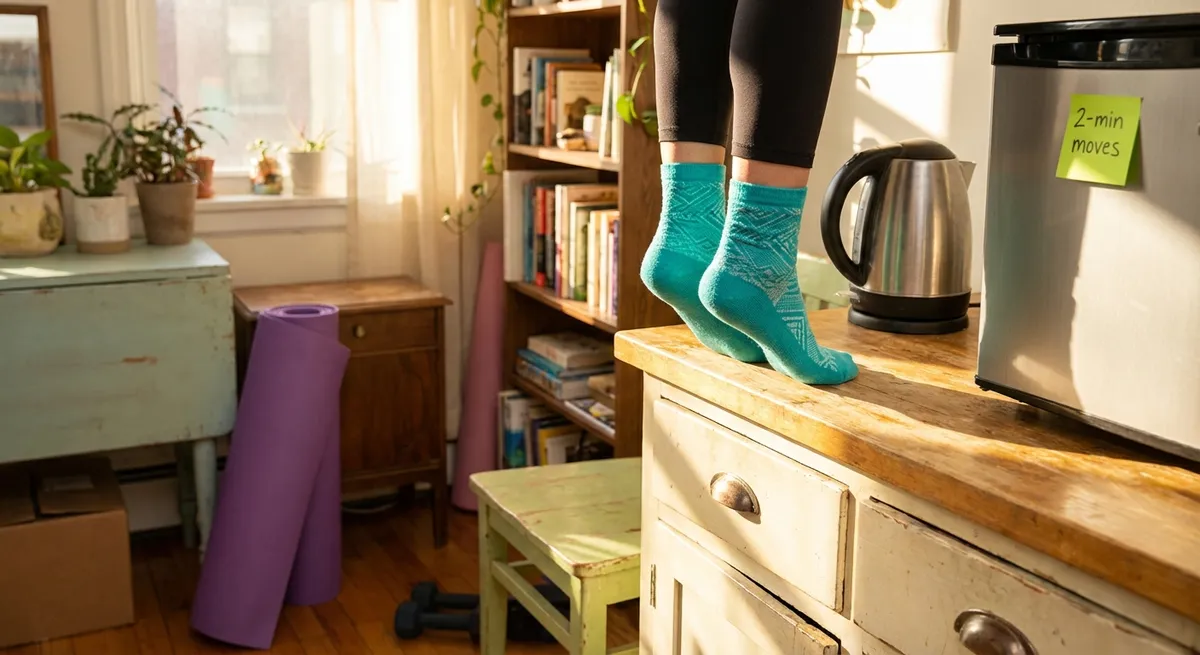
The water refill is already a habit; you’re just harnessing it as a built-in reminder. Even if you refill 3–4 times per day, that’s multiple “mini sets” that challenge your muscles and circulation. Plus, moving when you hydrate helps reduce the stiff, sluggish feeling that can come from long stretches of sitting.
If your day is chaotic, this stack guarantees at least a few meaningful movement hits—no extra planning required.
Quick Tip #4: The “One-Call Walkabout”
Trigger: Any phone call where you don’t absolutely need your keyboard or camera.
Action: Stand up and walk—around the room, down the hall, or in loops around your kitchen—until the call ends.
If pacing feels awkward, set a small rule: during the first minute, just stand; after that, walk. Or walk during the entire call but keep it simple and slow. Even low-intensity walking boosts blood flow, helps regulate blood sugar, and wakes up your brain, which can sharpen your focus for the conversation you’re actually having.
Over a day of scattered calls, you might stack 15–30 minutes of extra walking without carving out a “walk time.” That’s huge for people chained to screens most of the day. Bonus: many people find they think more clearly and creatively when they’re on their feet.
Quick Tip #5: The “Shutdown Stretch Sequence”
Trigger: Powering down your laptop or checking your phone for the final time at night.
Action: Perform a 2-minute, three-move stretch routine—no mat needed:
- Wall chest stretch (30 seconds each side) – Hand on a wall or doorframe at shoulder height, gently turn your body away to open your chest.
- Seated hip stretch (30 seconds each side) – Sit on a chair, cross one ankle over the opposite knee, gently lean forward.
- Forward fold (30–60 seconds) – Stand, soften your knees, hinge at your hips, and let your arms dangle toward the floor.
This combo counters all-day hunching, eases tight hips from sitting, and signals your nervous system that it’s safe to wind down. You’re not negotiating with yourself about doing “night yoga”—you’re just closing the day with a fixed mini-sequence tied to a tech habit you already have.
Over weeks, you’ll likely notice fewer “cement shoulders” in the morning and easier movement when you stand up, reach, or twist.
Conclusion
Micro habits are fitness on “stealth mode”—small enough that you’ll actually do them, powerful enough that your energy, strength, and mood start to shift. Anchor them to routines you already have, keep the bar low, and let repetition do the heavy lifting.
You don’t need a new personality or a new planner. You just need a few smart sparks—doorway squats, loading bar planks, water-move stacks, walk-and-talk calls, shutdown stretches—and your day quietly transforms into a low-friction fitness loop.
Start with one micro habit today. When that feels automatic, stack on the next. Tiny, consistent moves are how busy people secretly get fit.
Sources
- Physical Activity Guidelines for Americans, 2nd edition - U.S. Department of Health and Human Services overview on how different amounts and types of activity benefit health
- How Much Physical Activity Do Adults Need? - CDC guidance on weekly activity targets and the value of breaking movement into smaller bouts
- Exercise “Snacks” Before Meals: Impact on Glycemic Control - Research in Diabetes Care on short pre-meal activity bursts improving blood sugar control
- The Effects of Interrupting Prolonged Sitting With Activity Breaks - British Journal of Sports Medicine review on how brief movement breaks during sedentary time aid cardiometabolic health
- Physical Activity and Brain Health - CDC summary on how regular movement (including light activity) improves mood, cognition, and sleep
Key Takeaway
The most important thing to remember from this article is that this information can change how you think about Micro Habits.