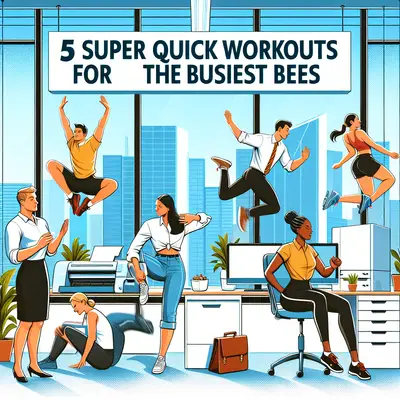
Busy doesn’t mean broken fitness goals. You don’t need a full hour, fancy gear, or a perfect schedule—you need tiny pockets of time that hit hard and count. These quick-hit tips are built for people who are constantly on the move but still want real results, not just “well, at least I tried.”
Let’s turn your “I don’t have time” moments into “Wow, that actually worked.”
Tip 1: Use the 5-Minute Burst Rule
No workout window? Create one. Grab any 5-minute gap (waiting for coffee, between meetings, pre-shower) and go all-in.
Pick one pattern and repeat it for 5 minutes:
- Lower body: 10 bodyweight squats + 10 reverse lunges
- Upper body: 10 incline pushups on a counter + 10 chair dips
- Cardio: 20 fast high knees + 10 squat jumps (or regular squats if impact is too much)
Set a timer and cycle through with as little rest as possible. Five minutes feels small, but three bursts spread through the day add up to 15 minutes of legit work—enough to boost strength and cardio when done consistently.
Tip 2: Turn Transitions Into Movement Triggers
Don’t rely on “when I have time.” Tie movement to stuff you already do.
Use simple rules like:
- After every bathroom break → 15 air squats
- After each Zoom call → 10 desk pushups
- Before you open Netflix → 30 seconds of fast marching or jogging in place
- Every time you refill water → 20 calf raises
These tiny, automatic moves stack up across the day and keep your body from sitting in one position for hours. You’re building a reflex: do normal life thing → move your body. That habit shift is where long-term consistency lives.
Tip 3: Go All-In With a 7-Minute Total-Body Circuit
When you’ve got a single short pocket of time, hit everything at once. Try this simple no-equipment circuit:
Do 30 seconds of work, 10 seconds of rest. Go through all moves once. If you have time, repeat.
Jumping jacks (or step jacks for low impact)
Squats
Incline pushups on a sturdy counter or desk
Alternating reverse lunges
Plank (on hands or forearms)
Glute bridges (on the floor, squeeze at the top)
Fast high knees or brisk marching in place
This combo hits legs, glutes, core, and upper body while getting your heart rate up. It’s short enough to squeeze in before a shower, after work, or while dinner is in the oven.
Tip 4: Make Your Commute or Chores Do the Heavy Lifting
You’re already moving—now make that movement work harder.
Try these upgrades:
- Walking commute or parking farther away? Add 60 seconds of “power pace” every few minutes.
- Standing in line or cooking? Light calf raises, glute squeezes, or mini squats.
- Stairs nearby? Walk them with purpose—2–3 trips at a strong pace is a legit cardio burst.
- Cleaning or doing laundry? Turn it into intervals: 2 minutes of fast cleaning, 30 seconds of squats or lunges, repeat.
You’re not “adding a workout” so much as turning daily life into low-key training.
Tip 5: Anchor Your Day With a Non-Negotiable 3-Move Mini Routine
Pick three moves that hit big muscle groups and feel doable on your worst day. Do them once a day—no excuses, no overthinking.
Example mini routine:
- 10–15 squats
- 10 pushups (on wall, counter, or floor—whatever level fits you)
- 20-second plank
If you feel good, add another round. If you’re exhausted, do just one. The power here isn’t the time—it’s the consistency. This tiny “anchor” keeps your fitness habit alive even when life is chaos.
Conclusion
You don’t need a perfect routine—you need a repeatable one. Five-minute bursts, built-in triggers, mini circuits, upgraded daily movement, and a simple three-move anchor can turn even the busiest schedule into a steady stream of wins.
Start with one tip today, not all five. When that feels automatic, layer in another. Your schedule doesn’t have to shrink for your fitness; your workouts just have to get smarter.
Sources
- Physical Activity Guidelines for Americans, 2nd edition – U.S. HHS - Official guidelines showing how short bouts of activity contribute to weekly totals
- How Much Physical Activity Do Adults Need? – CDC - Overview of recommended activity levels and benefits
- High-Intensity Interval Training for Health Benefits – Harvard Health - Explains why short, intense bursts can be effective for fitness and heart health
- Exercise: 7 Benefits of Regular Physical Activity – Mayo Clinic - Details wide-ranging health benefits of consistent movement
- The Scientific 7-Minute Workout – The New York Times / Well Blog - Describes a research-based short high-intensity circuit for time-crunched people
Key Takeaway
The most important thing to remember from this article is that this information can change how you think about Quick Workouts.