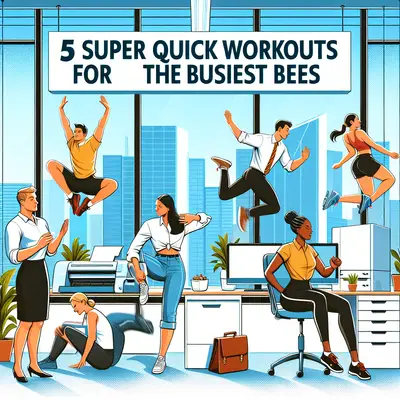
Busy day, zero spare time, and you still want to feel like you actually worked out? You’re in the right place. Quick-burst fitness is all about focused, time-efficient moves that deliver real results without hijacking your schedule. No 90-minute gym saga. Just sharp, targeted sessions you can slide into real life—between meetings, during lunch, or before your coffee even cools.
Why Quick-Burst Workouts Actually Work
Short doesn’t mean weak. When you push with intention, you tap into intensity instead of duration, and your body absolutely responds. High-effort intervals can elevate your heart rate, challenge major muscle groups, and keep your metabolism humming even after you’re done—this is often called excess post-exercise oxygen consumption (EPOC), or the “afterburn” effect.
The key isn’t doing everything; it’s doing the right things, back-to-back, with minimal fluff. Compound moves (think squats, push-ups, lunges) recruit multiple muscles at once, giving you more “fitness per minute.” Add short bursts of higher intensity and you’ve got a mini power session that can improve strength, cardio capacity, and energy levels in a fraction of the time you expect.
Tip 1: Turn 5 Minutes Into a Total-Body “Power Block”
When you only have five minutes, you can still hit every major zone—legs, core, upper body, and lungs. Try this quick “Power Block”:
- 40 seconds bodyweight squats
- 20 seconds rest
- 40 seconds push-ups (incline on a counter if needed)
- 20 seconds rest
- 40 seconds reverse lunges
- 20 seconds rest
- 40 seconds plank
- 20 seconds rest
- 40 seconds fast marching or jogging in place
- 20 seconds rest
That’s it. One round. Hit it once before a shower or between tasks. If you’ve got more time later, repeat another round. This structure keeps your heart rate up while cycling muscle groups so you don’t burn out in minute one.
Tip 2: Make Your Commute or Errands a Sneaky Cardio Session
You don’t always need “gym clothes” to get legit cardio work. Upgrade how you move through the day instead of trying to carve out a separate window you never get.
Walking to the train? Turn the last 5 minutes into a brisk, arms-swinging power walk. Parking at the store? Pick a spot farther away and walk the lot at a quick clip. Take the stairs and treat them like a mini hill workout: climb with intent, drive through your legs, and maintain a steady rhythm.
Use simple rules: elevator down, stairs up; slow walk → brisk walk whenever you’re alone; phone in your pocket instead of in your hand. These small upgrades add up to real training volume spread across your day—without booking a single “workout block” on your calendar.
Tip 3: Use the “Meeting Buffer” Method for Micro Strength Bursts
Those awkward 5–10 minutes before a call? Perfect micro strength window. Instead of doom-scrolling, keep two or three bodyweight moves on rotation and hit a quick circuit.
Example “buffer burst” (3–6 minutes):
- 10–15 chair squats
- 10 incline push-ups on a desk or counter
- 10–12 standing calf raises
- 20 seconds wall sit
Cycle through as many rounds as your buffer allows, moving smoothly with control. You stay close to your laptop, you don’t break into full sweat mode, and yet you’re quietly stacking reps all day. Over a week, those little blocks can add up to hundreds of reps without ever blocking out a formal gym session.
Tip 4: Try the “Every Hour, One Move” Strategy
If your day is glued to a desk, make movement automatic with a single rule: every hour, do one move. Not a whole workout. Just one focused exercise for 30–60 seconds.
Pick from this menu:
- Jumping jacks
- High-knee march in place
- Wall push-ups
- Standing hip bridges (press hips forward, squeeze glutes)
- Standing knee-to-opposite-elbow crunches
Set a silent reminder or link it to something that already happens, like finishing an email or refilling water. It’s low-friction, low-embarrassment, and surprisingly high-impact on stiffness, energy, and daily calorie burn. The consistency matters more than the perfection of the move.
Tip 5: Level Up TV Time With “Commercial Round” Intervals
If evenings are your only downtime, don’t fight it—upgrade it. During ads or between episodes, hit a quick interval round. Your show becomes your built-in timer, and you’ll associate movement with relaxation instead of seeing it as competition for your chill time.
Try this “Commercial Round” routine:
- Round 1: 30 seconds squats + 30 seconds marching in place
- Round 2: 30 seconds glute bridges (on the floor or couch edge) + 30 seconds core hold (plank or dead bug)
- Round 3: 30 seconds triceps dips on the couch + 30 seconds fast feet (quick steps in place)
If your stream has no ads, set a timer every 10–12 minutes. You’ll still watch everything, but instead of passively sinking into the couch for an hour, you’ll finish the episode with your heart rate up and muscles pleasantly worked.
Conclusion
You don’t need a clean slate day or a perfect schedule—you just need a few focused minutes and a clear game plan. Quick-burst workouts plug into the life you already have: tiny power blocks, smart commuting, hourly movement hits, and upgraded downtime. Start with one of these tips today, keep the bar ridiculously low for “success,” and let consistency—not perfection—do the heavy lifting for your fitness.
Sources
- American College of Sports Medicine – High-Intensity Interval Training - Overview of how short, intense intervals can improve fitness efficiently
- Harvard Health – The Truth About Exercise and Weight Loss - Explains how regular, even brief activity supports health and weight management
- Mayo Clinic – Exercise: 7 Benefits of Regular Physical Activity - Summarizes broad health benefits of staying physically active
- CDC – How Much Physical Activity Do Adults Need? - Provides official guidelines and notes that activity can be accumulated in short bouts
- NHS (UK) – Why We Should Sit Less - Details risks of prolonged sitting and the value of frequent movement breaks
Key Takeaway
The most important thing to remember from this article is that this information can change how you think about Quick Workouts.