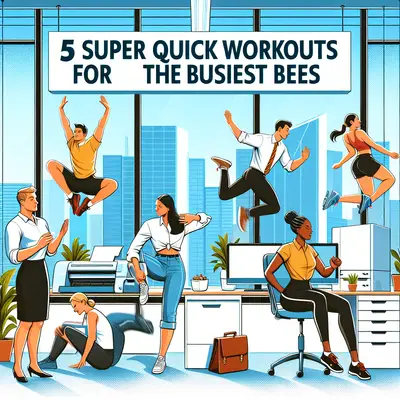
If your to‑do list looks like a traffic jam, your workout shouldn’t. Quick workouts aren’t “fitness lite”—they’re smart, targeted energy boosts that keep you strong, clear-headed, and on your game. You don’t need a gym, fancy gear, or a spare hour. You just need a plan and a few fierce minutes.
Let’s turn tiny time windows into legit fitness wins.
Why Quick Workouts Actually Work
Fast doesn’t mean fake. Short, focused sessions can deliver serious benefits because they crank up intensity instead of time. Think of them as espresso shots for your body and brain.
When you move hard for a few minutes, your heart rate spikes, blood flow improves, and your muscles wake up fast. That means more energy, sharper focus, and better mood—without needing a 60‑minute block on your calendar. Research on high-intensity and “exercise snacks” shows that even brief bouts of movement can improve cardiorespiratory fitness, blood sugar control, and overall health markers.
Quick workouts are also easier to start—and what you start, you’re more likely to keep doing. That consistency is where real progress hides. Stack a few short sessions into your week and your body can’t tell the difference between that and one long marathon of a workout. It just knows you’re showing up.
Tip 1: The “First 5 Minutes” Wake-Up Circuit
Before you touch your inbox or scroll anything, give your body the first five minutes of your day. No mat, no equipment—just you and the floor.
Try this simple routine, cycling through it for 5 minutes:
- 30 seconds fast marching in place (pump your arms)
- 30 seconds bodyweight squats
- 30 seconds wall pushups or knee pushups
- 30 seconds alternating reverse lunges or step-backs
- 1 minute gentle stretching (hamstrings, chest, shoulders)
Then loop it from the top until your 5 minutes are up.
This wake-up circuit:
- Fires up your muscles before you sit all day
- Gets blood flowing to your brain so you’re more alert
- Counts as real training volume if you do it daily
Miss your “real” workout? You still got quality movement in before breakfast.
Tip 2: The 60-Second Power Burst Between Tasks
Waiting for a file to download, coffee to brew, or a meeting to start? Use that stray minute as a power burst instead of a doom-scroll break.
Pick one move and go for 60 seconds:
- Fast squats
- Chair or desk pushups
- Standing calf raises
- Wall sit
- High knees or marching in place
Rotate different moves throughout the day so you’re not hammering the same muscle group every time.
These tiny bursts:
- Break up long sitting time, which is tied to higher health risks
- Give you a mini mood and focus boost before the next task
- Add up—10 random minutes of movement a day = over an hour a week
You’re not “stealing time” from work; you’re buying focus for what’s next.
Tip 3: The “Commute Crusher” Mini Cardio Block
Whether your commute is a drive, a bus ride, or a walk from bedroom to living room, anchor 5–10 minutes of movement to it. Same event, every day, same fitness trigger.
Options before or after your commute:
- Walk at a pace that makes talking slightly harder
- Climb stairs for 5 minutes (up and down, safely)
- Bike around the block or on a stationary bike
- Do a simple interval: 30 seconds faster, 30 seconds easier, repeat
- Build a habit that doesn’t depend on motivation
- Turn a daily “must-do” into an automatic workout window
- Sneak in heart-health work without needing gym time
By tying this to your commute, you:
No commute? Use the transition from “workday done” to “home time” as your trigger.
Tip 4: The 8-Minute Strength Sandwich
Strength training doesn’t have to be an hour with barbells. An 8‑minute “strength sandwich” hits multiple muscle groups fast: 3 moves, quick rests, repeat.
Try this:
- 40 seconds squats or sit-to-stands from a chair
- 20 seconds rest
- 40 seconds pushups (wall, counter, or floor)
- 20 seconds rest
- 40 seconds hip hinge (deadlift motion with no weight, focusing on glutes/hamstrings)
- 20 seconds rest
That’s one round (3 minutes). Do 2–3 rounds depending on time and energy.
Why this works:
- You’re targeting legs, chest, shoulders, and posterior chain
- You build strength that supports posture, joints, and daily tasks
- It’s short enough to slide between meetings or right before a shower
Progress by going a little deeper, a little slower, or adding light weights when you can.
Tip 5: The “Screen Time Swap” Cooldown Routine
Instead of ending your day doom-scrolling in bed, swap 5–10 minutes for a slow-and-easy cooldown routine. This still counts as a workout win, and it helps your body unwind.
Try:
- Gentle neck rolls and shoulder circles
- Cat-cow stretches on the floor or at the edge of your bed
- Seated or standing hamstring stretch
- Hip flexor stretch (half-kneeling lunge)
- Deep breathing: inhale for 4, exhale for 6–8
- Releases tension from sitting and stress
- Signals your body that it’s time to power down
- Improves flexibility and may help you sleep better
Benefits:
You finish the day actually recovering, not just collapsing.
Conclusion
Quick workouts aren’t a backup plan—they’re a power strategy for busy lives. Five minutes before work, a minute between tasks, a tiny block after your commute: those bite-sized moves are how you build a body that keeps up with your brain.
You don’t need a perfect plan. You just need a next move. Pick one of these tips, plug it into today’s schedule, and let your quick hit turn into big energy.
Sources
- Physical Activity Guidelines for Americans, 2nd edition – U.S. Dept. of Health & Human Services - Outlines evidence-based recommendations for aerobic and strength activity, including benefits of breaking movement into shorter bouts
- High-Intensity Interval Training for Health Benefits and Care of Cardiac Diseases – NIH/NCBI - Reviews research on how brief, intense workouts can improve cardiovascular fitness and health markers
- Exercise “Snacks” Improve Cardiorespiratory Fitness – McMaster University - Summarizes studies showing that short bursts of stair-climbing and similar efforts can boost fitness
- Sedentary Time and Its Association with Risk for Disease – Mayo Clinic Proceedings00125-8/fulltext) - Discusses the health impact of prolonged sitting and the importance of breaking it up with movement
- How Much Sleep Do We Really Need? – Harvard Medical School - Explains the role of routines, relaxation, and physical activity in supporting healthy sleep
Key Takeaway
The most important thing to remember from this article is that this information can change how you think about Quick Workouts.